
How to Make Your Dorm Room Comfortable, Organized, and Actually Yours
The summer before my daughter heads to college, I keep thinking about the first dorm room I ever designed — not for a client, but for my little brother. That 10-by-12-foot cinder block box taught me more about bedroom design than any master suite. A dorm room is the ultimate test: you're making a private, restful space inside a shared building with rules, thin walls, and a bed that's seen better decades. Here's the plan I'd use for any small space.
Actually, one more thing: it doesn't have to be perfect. It just has to be yours. That rule matters even more when the room is the size of a parking space.
Start With the Bed, Because It's Your Whole Apartment
The dorm room bed is not a bed; it's a couch, a desk, a dining table, and sometimes a trampoline for your roommate's friend. The mattress will be perpetually questionable, so a waterproof mattress pad is non-negotiable. The $25 one from Target works fine. Add a 3-inch memory foam topper — about $80 on Amazon — and your back will thank you during midterms.
Then bedding. All-white sheets are a terrible idea in a dorm because the laundry room is chaos. Buy a cheap but soft duvet cover in a color that won't make you hate life in February. I like the $40 percale duvet covers from Target's Threshold line. Bring two sets of pillowcases, and get a zippered mattress topper cover so it doesn't slip off.

Storage That Survives a Shared Space
A dorm room comes with maybe one closet and a desk. That's not enough. The key is vertical storage and a place for the stuff you pick up every day. In my little brother's room, we used an IKEA RÅSKOG utility cart ($35) as a nightstand and a charging station. It holds water bottles, books, AirPods, and a lamp, and it wheels right next to the bed.
For clothes, don't rely on the closet alone. A hanging organizer with six shelves (about $15) doubles your closet space. Under the bed, use flat storage bins that slide. And get a small over-the-door hook rack for jackets and bags. That alone keeps a dorm room from looking like a tornado hit it.
Lighting Is the Cheapest Design Upgrade on This List
Here's what every dorm room has: a ceiling light that's either fluorescent or dim enough to feel like a cave. Neither works. You need three light sources: task, ambient, and accent. A clip-on desk lamp for studying, a warm LED floor lamp for reading in bed, and a small string light for the "this is mine" feeling.
Don't spend more than $60 total. I'd pick an LED desk lamp with a USB port — $25 from IKEA — and a floor lamp with a fabric shade from Target for $35. Skip the expensive "dorm lighting kits" you see online. They're overpriced and mostly cold light.
The "Third Thing" Rule for Cinder Block Walls
Cinder block walls don't take nails, and command strips can only hold so much. Instead of covering every wall with random posters, use the third thing rule: pick one accent wall for a big piece of art or a tapestry, one wall for a cork board with photos and schedules, and leave the rest alone. Your dorm room will feel calmer and bigger than the rooms where people tape up every single thing.
Skip the futon mattress on the floor. A large floor pillow or two foldable chairs are better, and they take up less space than a beanbag. Also skip decor that says "college." You'll hate it by Thanksgiving. Choose things you'd actually want in a real apartment — a simple lamp, a woven basket for blankets, a real plant (a pothos or snake plant, both impossible to kill).
Make the Space Do Double Duty for Study and Sleep
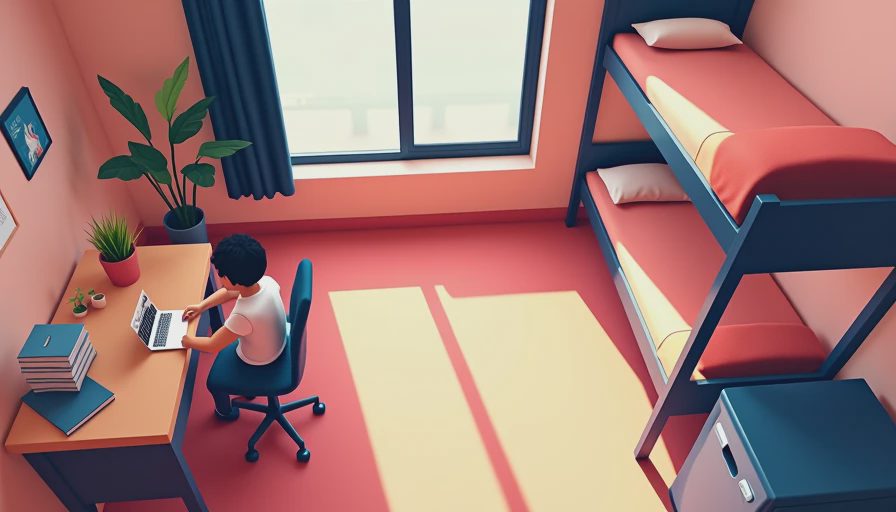
It's hard to focus in a room where you also eat and nap. Create a visual boundary: when you sit at the desk, turn your body away from the bed. A trifold room divider doesn't help — they just eat floor space. Instead, use a tall bookshelf or a tension rod with curtains to separate your sleeping corner from your desk if the layout allows.
If it doesn't, the trick is a desk lamp aimed at your work, not at the whole room. Your brain will learn that the circle of light means "studying," and the dark corner means "sleeping." That's the same trick I recommend for adults with home offices. Set your phone on the desk, not in bed. A cheap alarm clock is better. You'll sleep more and scroll less.
What You Actually Don't Need (Skip These)
Every year, stores sell a mountain of "college essentials" you don't need: the 12-piece bedding set with a matching comforter you'll wash twice, a shoe organizer that doesn't fit the door, a desk lamp that's purely decorative. Skip the overpriced kits. Buy only what your building allows and your routine actually uses.
If you're the one paying, start with a budget of $300 for the entire setup. The bed topper, storage, lighting, and one wall decor should get you there. If you have leftover money, spend it on quality sleep — a fan, a white noise machine, or earplugs. Those matter more than decor.
That first little room taught me that the best rooms are the ones that work when life gets messy. Your dorm room doesn't have to be perfect. It just has to be yours. Start with the bed, add some light, and bring one thing that makes you happy. Everything else is just stuff.