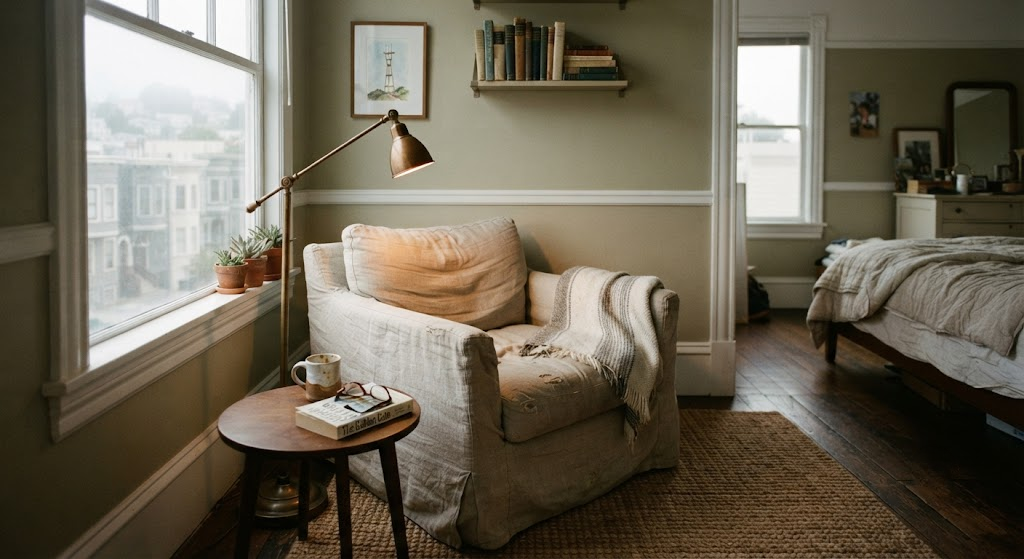
I‘ve designed exactly one reading nook that worked on the first try. The others all failed in the same way: they looked beautiful and nobody sat in them. The chair faced the wrong direction. The light was too bright or too dim. The side table was too far away to reach a coffee cup without leaning forward awkwardly. After six months, the nook became a clothing pile, and the client went back to reading in bed.
A bedroom reading nook fails when it’s designed for photos instead of people. The fix isn‘t more money or more square footage. It’s three things: the right chair, the right light, and the right positioning. Get those right, and you‘ll use the nook every night. Get them wrong, and you’ve bought an expensive laundry rack.
The Chair
Don‘t buy a chair that matches your bedroom set. Buy a chair you’d want to sit in for two hours. For me, that‘s an armchair with a low back and wide armrests — something I can curl up sideways in, legs tucked under a throw. Sophie reads in a beanbag. Tom reads on a small upholstered bench. The point is comfort, not coordination.
Test the chair in person. Sit in it for ten minutes with your phone. If you’re shifting your weight after two minutes, it‘s the wrong chair. The best reading chair for bedroom corners supports your lower back and has arms at a height where your elbows rest naturally while holding a book. Skip anything with a straight back, no arms, or a seat so deep your feet don’t touch the floor.
The Light
Overhead light is useless for reading. You need a dedicated floor lamp or wall-mounted sconce positioned directly over your shoulder, with the bulb at about 48–56 inches from the floor. Too high and the light hits the top of your head. Too low and it casts shadows across the page. A swing-arm or gooseneck design lets you adjust the angle without moving the whole lamp.
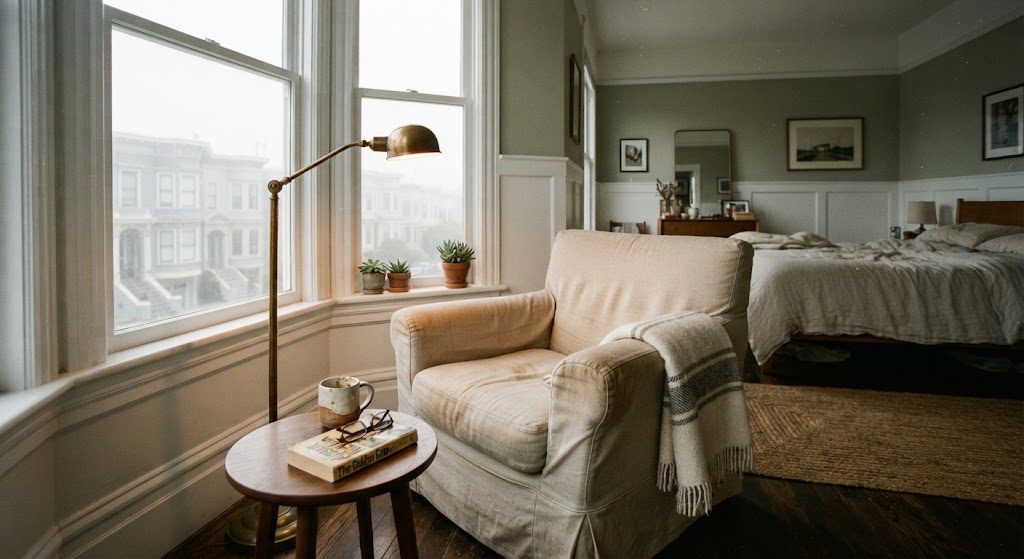
Use a warm bulb — 2700K to 3000K — with at least 450 lumens. That‘s bright enough to read by without feeling like an interrogation room. I learned this after installing a 60-watt equivalent LED in my first reading lamp and realizing I was squinting by page ten. Bedroom reading light strength matters more than the fixture. Buy the bulb after you buy the lamp.
The Positioning
This is the rule most people miss: the chair should face into the room, not into a corner. A chair pushed against a wall facing a corner feels like time-out. A chair angled slightly toward the center of the bedroom, with a window or a bookshelf in view, feels like a deliberate retreat. I position my reading chair so I can see the bedroom door and the window without turning my head. It sounds minor, but it’s the difference between a corner that beckons and a corner that collects laundry.
What Else You Actually Need
A small side table within arm‘s reach of the chair — close enough to set down a mug without leaning. A throw blanket within grabbing distance, not draped decoratively three feet away. A place to put your feet: an ottoman, a pouf, or just a folded floor cushion. The best cozy bedroom corner setups have zero decorative items that aren’t also functional.
My Reading Nook
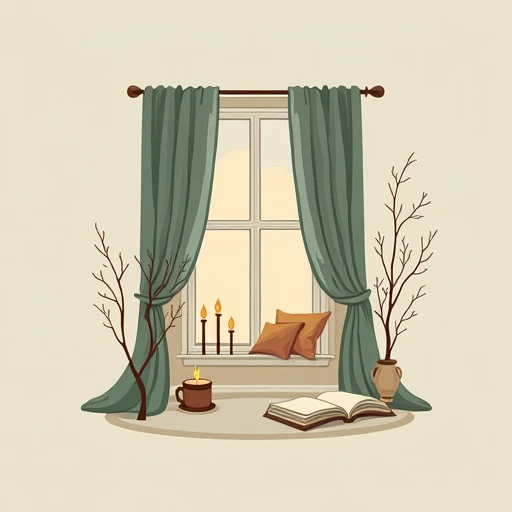
Our bedroom is 12 by 14 feet. The nook takes up about 16 square feet in the corner farthest from the bed — just enough for a small armchair, a floor lamp, and a tiny round side table I found at a garage sale. The chair faces the window, angled so I can see the door. The lamp is a brass gooseneck floor lamp I‘ve had since my first apartment. The throw is wool, scratchy in a way that feels good.
I read there three or four nights a week. Sophie reads there on weekends. The chair has never once held a pile of laundry. That’s how I know it works.