I used to think I was good at designing kids’ rooms. Before Sophie was born, I’d done a half-dozen nurseries for clients — soft gray walls, tasteful animal prints, a single well-placed mobile. I assumed I’d do something similar for my own child, maybe with a little more personality. Then Sophie turned four and announced she wanted “hot pink everything.” Not a pale blush accent wall. Not a tasteful salmon throw pillow. Hot pink. The kind that hums.
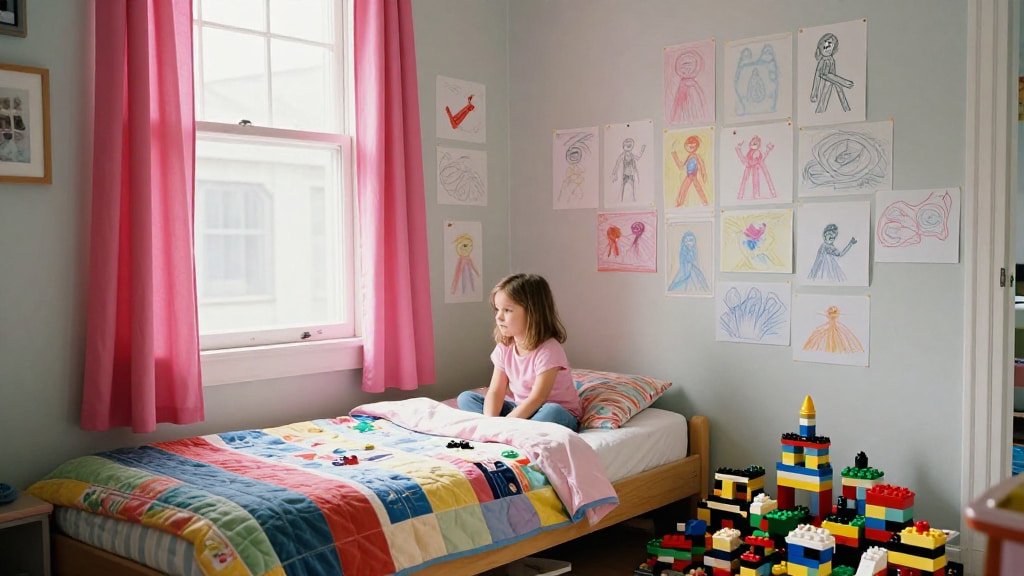
I resisted for about a week. I sketched alternatives that were “more versatile.” I showed her swatches of dusty rose and muted coral. She looked at me like I’d suggested we paint the walls oatmeal and call it a day. Eventually, I remembered something I used to tell my clients: it’s your kid’s room, not yours. So we painted one wall hot pink. Then we hung hot pink curtains. Then Sophie added a hot pink beanbag chair she picked out herself at a garage sale for three dollars. The room should’ve been a disaster. Instead, it became the most functional, joyful space in our house — and it taught me more about kids bedroom design than any client project ever did.
Let Go of the “Perfect” Kid’s Room
Most kids room ideas on Pinterest look like they were designed by an adult who forgot children actually live there. Matching furniture sets, themed bedding that the kid didn’t choose, and not a single toy in sight. That version of a kid’s bedroom is beautiful in photos and useless in real life. Sophie’s room is an active construction site for LEGO castles, a dance studio for impromptu ballet performances, and a gallery for her ever-changing collection of drawings. It can’t be precious. It has to work.
The Hot Pink Compromise
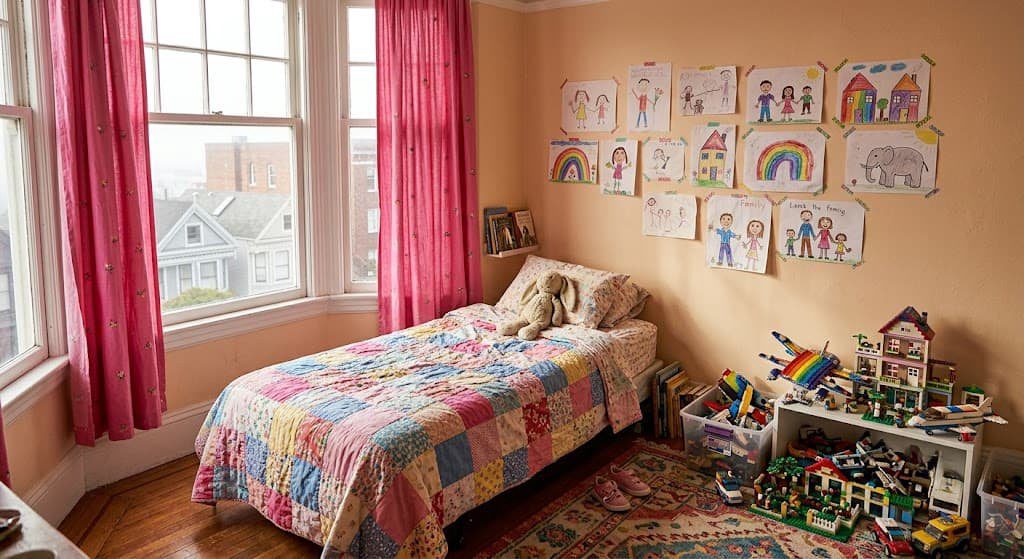
Here’s how I handled the color situation. Sophie wanted hot pink on every surface. I wanted to still be able to sell the house someday. Our compromise: one accent wall in a saturated magenta, plus accessories — curtains, a lamp, a few storage bins — in the same bold tone. The other three walls stayed a warm white that bounces light around the room, which matters in San Francisco where the fog can make everything feel gray by 3 p.m. The result is a room that reads as unmistakably Sophie’s, but won’t require three coats of primer if we ever change it.
The lesson: kids bedroom colors don’t have to be a fight. Give them one wall or one big piece — a rug, a bedspread, a curtain panel — to go wild with. Keep the bones neutral so the room can evolve as they do.
Storage That Survives a 7-Year-Old
Sophie’s room is small — a typical San Francisco bedroom, roughly 10 by 11 feet. Every inch of storage has to earn its place. When she was younger, I could control the toy situation with a few bins. Now she has LEGO sets with hundreds of tiny pieces, art supplies that multiply overnight, and a rotating cast of stuffed animals that she insists all need “breathing room.”
The LEGO Storage Solution That Actually Works
I tried drawer organizers, labeled bins, even a rolling cart with color-coded trays. All of them failed within weeks. What finally worked: a low open shelf unit with shallow plastic trays that slide out like drawers. Each tray holds one category — minifigures, bricks by color, half-finished projects she’s “still working on.” The open design means she can see everything without dumping it on the floor, and the shallow depth means nothing gets lost at the back. For small kids room storage, open and shallow beats deep and lidded every time.
Artwork Management Without the Guilt
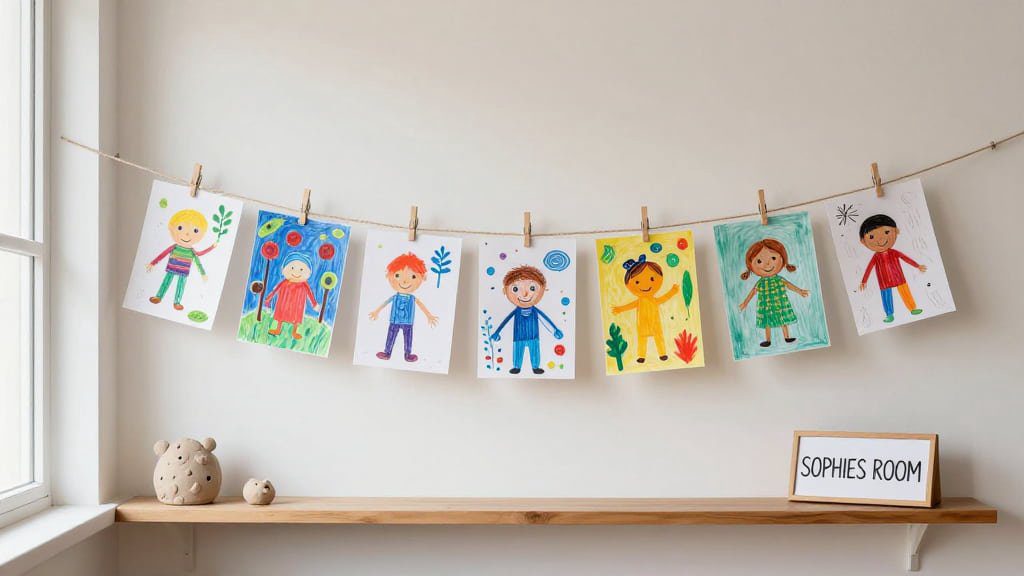
Sophie produces roughly 14 drawings per week. I love every one. I cannot keep every one. Our system: a length of twine stretched across one wall with small wooden clips. Current favorites go on the line. When the line is full, Sophie chooses which ones stay and which ones go into a flat storage box under her bed. Once a season we go through the box together. It’s not a parent-imposed purge; it’s an editing process she participates in. This simple kids room organization trick has saved more tears than any filing system ever could.
Designing With a Kid, Not Just for Them
The biggest shift in my approach came when I stopped treating Sophie’s room as my design project and started treating her as a collaborator. She has strong opinions, and most of them are valid. She knows she wants her bed near the window so she can watch the fog. She knows she needs a clear space on the floor for dancing. She knows the dresser drawers should be low enough that she can reach them without help.
The Make-It-Your-Own Wall
One entire wall in Sophie’s room is dedicated to her creations. It started as a strip of corkboard tiles, then expanded to include magnetic panels and a low shelf for 3D projects. Right now it holds a watercolor of a rainbow dolphin, a clay sculpture of a cat that looks slightly haunted, and a handwritten sign that says “SOPHIES ROOM” with the apostrophe missing. She changes it constantly. It’s the first thing she shows visitors and the last thing she adjusts before bed.
When parents ask me for big girl room ideas or big boy bedroom design advice, I always say the same thing: leave space for them to change their mind. Their tastes evolve monthly. The room should be flexible enough to accommodate a new obsession — dinosaurs, space, ballet, Taylor Swift — without requiring a total overhaul.
What I’d Do Differently Next Time
I’d buy the trundle bed earlier. Sophie’s first “big kid” bed was a twin with no guest option, which meant sleepovers involved an air mattress that deflated by midnight. A trundle pulls out when a friend stays over and tucks away when she needs floor space. Best $200 I ever spent on her room.
I’d also invest in better blackout shades from the start. San Francisco fog is lovely until it clears at 5 a.m. and the sun hits her window like a spotlight. A good blackout shade with a cordless mechanism — safe for kids and easy for small hands to operate — makes the difference between a 6 a.m. wake-up and a reasonable hour.
Finally, I’d worry less. A kid’s bedroom doesn’t need to look like a magazine. It needs to feel like a place where your child can sleep deeply, play hard, and wake up knowing this is their corner of the world. Sophie’s hot pink curtains are ridiculous and I love them. They’re staying until she decides they’re not.