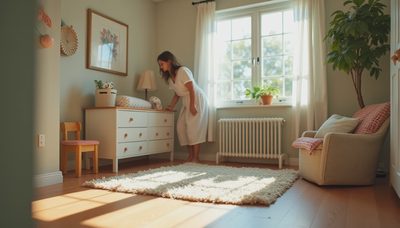
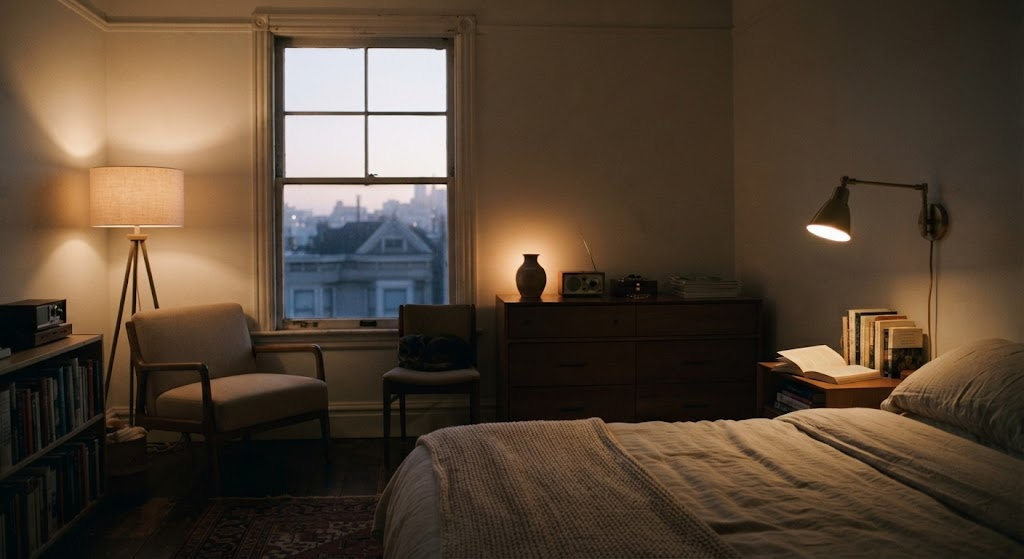
The fastest way to make a bedroom feel cold and unwelcoming is to light it with a single ceiling fixture. I walk into homes all the time — friend's houses, former clients' places, my own damn bedroom for the first three years we lived here — and the lighting plan is just one switch by the door. Flip it on, and the whole room is flooded with the same flat, overhead light that makes everyone look tired and every corner feel institutional.
Bedroom lighting ideas that actually work don't require an electrician or a renovation budget. They require thinking in layers. I taught this to every client for eight years, and I still use the same approach in my own Sunset district home, where the morning fog can make a room feel like a cave by 4 p.m. if the lights aren't working with you. Here's the system.
Why One Light Source Fails
A single overhead light — usually a flush-mount "boob light" installed by a builder who didn't care — creates three problems. First, it casts unflattering shadows straight down, which means bags under your eyes look deeper and every wall color reads as flat. Second, it gives you exactly one mood: full brightness or total darkness, nothing in between. Third, it ignores the fact that a bedroom serves multiple functions. You need bright light for folding laundry and putting away clothes. You need soft light for winding down before bed. You need focused light for reading without disturbing your partner. One switch can't do all that.
Good bedroom lighting design layers three types of light — ambient, task, and accent — and lets you control them independently. Once you see a room lit this way, you can't un-see how bad a single overhead fixture feels.
The Three Layers Every Bedroom Needs
Ambient Lighting: The Foundation
Ambient light is your room's general illumination — the soft, overall glow that fills the space without calling attention to itself. It's not the star of the show, but it's the thing that makes everything else work. In my bedroom, the ambient layer is a simple linen drum shade on a dimmer switch, centered on the ceiling. The dimmer is non-negotiable. Ten dollars at the hardware store, ten minutes to install, and suddenly you have infinite control over the room's mood.
If you can't or don't want to hardwire a ceiling fixture, a floor lamp in the corner with a warm, diffused shade does the same job. I've used the IKEA NOT floor lamp in client projects and my own home — it bounces light upward and off the ceiling, which creates a much softer effect than a lamp that points light directly at your face. For master bedroom lighting on a budget, this single move — one floor lamp with a warm bulb — gets you 80% of the way there.
The bulb temperature matters more than the fixture. Look for 2700K to 3000K. That's the warm, golden range that mimics candlelight and signals to your brain that it's time to wind down. Anything above 3500K starts to feel like a kitchen or a hospital room. I learned this the hard way after installing "daylight" bulbs in our bedroom and wondering why Tom couldn't fall asleep for a week.
Task Lighting: The Workhorse
Task lighting is focused, directional light for specific activities — reading in bed, putting on makeup at a vanity, digging through a dresser drawer for matching socks. This layer needs to be bright enough to prevent eye strain but contained enough that it doesn't flood the room and wake up your partner.
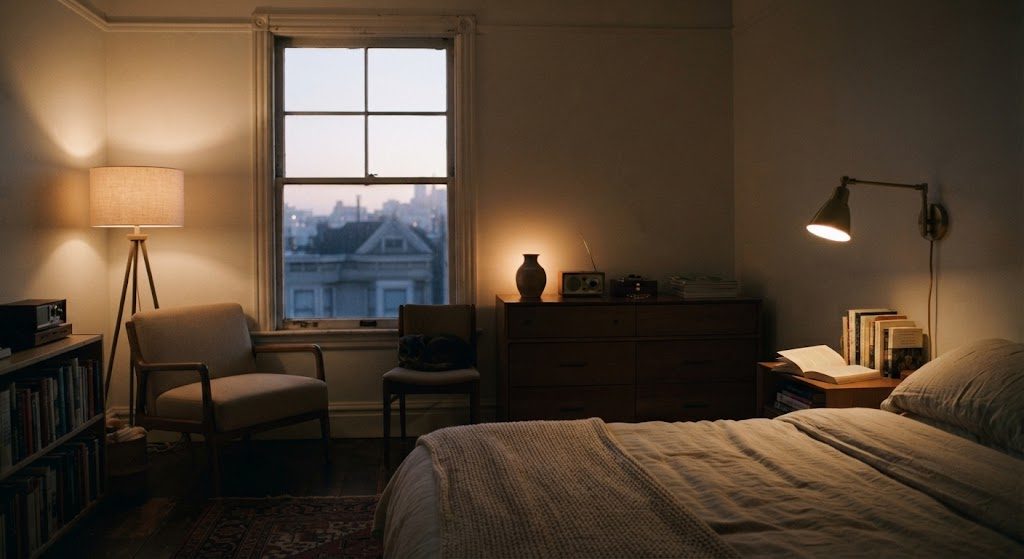
My favorite solution is a swing-arm wall sconce next to the bed. It mounts to the wall, frees up precious nightstand space, and the adjustable arm lets you position the light exactly where you need it. I installed one on my side of the bed two years ago and it's the single best bedroom task lighting decision I've made. Tom's side has a small ceramic table lamp with a linen shade — less precise, but he's usually looking at a screen anyway.
If hardwiring isn't an option, plug-in wall sconces with cord covers exist and work beautifully. No electrician needed. For Sophie's room, we use a clip-on book light attached to her headboard so she can read Owl Diaries without getting out of bed to turn off the overhead light. Small solution, massive improvement in bedtime cooperation.
The key with task lights: each one should be independently controllable. Don't wire them all to one switch. Give each bedside its own lamp or sconce, with its own switch or pull chain, so one person can read while the other sleeps. That's the difference between a room that works for two people and a room that works against them.
Accent Lighting: The Finishing Touch
Accent lighting is the smallest layer — a tiny glow that highlights something specific and makes the whole room feel intentional. It's the difference between a bedroom that's merely lit and one that feels designed.
I keep a small plug-in nightlight behind a vase of dried eucalyptus on my dresser. It casts a subtle, warm silhouette against the wall, and at dusk it makes the whole corner feel composed. In Sophie's room, we strung a set of warm LED fairy lights along the top of her bookshelf. They're on a timer and turn off an hour after bedtime. She calls them her "dream lights." Total cost: $12.
Other accent ideas: a small picture light over a piece of art you love, an LED strip tucked under a floating shelf, a tiny lamp on a dresser that illuminates nothing useful but makes you smile. Accent lights should be low-wattage — think 4 to 7 watts, or the lowest setting on a dimmable bulb. Their only job is to make something look beautiful and signal that this room is a place to rest, not a place to work.
How to Put It All Together
Here's what I did in my own bedroom, for under $200 total:
Ambient: IKEA NOT floor lamp in the corner ($70), warm 2700K LED bulb, plugged into a smart outlet so it turns on automatically at sunset
Task: Swing-arm wall sconce on my side of the bed ($45, plug-in with cord cover), ceramic table lamp on Tom's side ($30, thrifted)
Accent: Plug-in nightlight behind eucalyptus on the dresser ($8), small battery-operated picture light over a framed photo on the wall ($15)
Three layers. Independent controls. No electrician. The room transforms from flat and functional to warm and intentional just by reaching for different switches throughout the evening.
One Common Mistake to Avoid
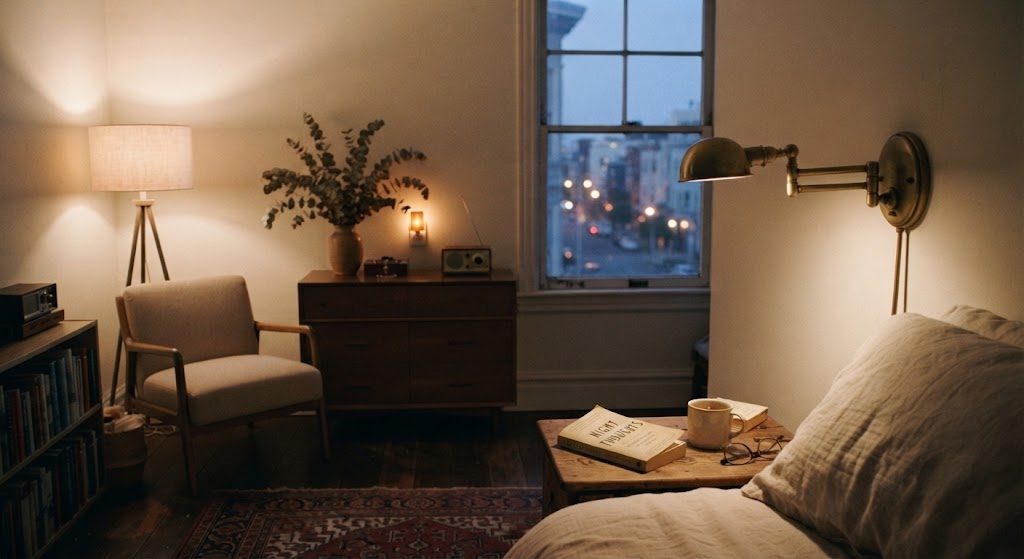
Don't put all three layers on the same circuit. If everything turns on with one switch, you've just recreated the single-overhead-light problem with more bulbs. The whole point of layered bedroom lighting is that you can choose what's on and what's off. Ambient for daytime puttering. Task for bedtime reading. Accent for winding down. Mix and match to match your mood and the time of day.
Start With One Layer This Weekend
You don't need to buy everything at once. Start with ambient — add a floor lamp or swap your overhead bulb for a dimmable one. Live with it for a week. Then add task lighting where you actually need it. Accent comes last, once the first two layers feel right.
Good lighting doesn't require a designer's eye or a contractor's invoice. It just requires thinking about how you use the room at different times of day, and giving yourself options beyond on and off. Your bedroom will feel better the first evening you switch from overhead to floor lamp. I promise.